“Could global warming be detected?” The 25-year record (2000-2024) of Reefcheck Kushimoto, Wakayama, Japan
ReefCheck Kushimoto Team - Sangodai, Kushimoto, Wakayama 649-3514, Japan
Corresponding author: K. Nomura - E-mail: alpheus.nomura@nifty.com - Communicated by Takashi Nakamura (Editor-in-Chief)
Note: Published in Japan Coral Reef Society 2025, the original English abstract is attached below. The following parts of this article are translated and summarized from the Japanese content of the publication.
Abstract
While conducting Reef Check, a global coral reef monitoring program, in Kushimoto, which is located in a non-reef area at a high latitude (33oN, 135oE), we supplemented many local species with the world standard as survey targets. In addition, we set a new objective for the survey to detect global warming through changes in marine fauna. The survey was conducted over a 25-year period from 2000 to 2024, basically following the Reef Check methodology. The survey results showed a significant decline in native tropical species. Furthermore, changes in marine fauna indicative of global warming, such as the decline of temperate species and the increase of non-native tropical species, were hardly detected. These findings were attributed to the fact that the shallow marine communities in Kushimoto are more strongly influenced by the Kuroshio Current than by global warming.
Method
From 2000 to 2024, annual coral reef surveys were conducted around May–June in Kushimoto, Japan, by mixed teams of 3–18 volunteer recreational divers, professional divers, and marine biologists. The surveys followed the standard Reef Check methodology with local adaptations. Two fixed sites at different depths (3 m and 10 m) were established along the northeastern coast of Sō Island (Sōshima), Kushimoto, with a 100-meter transect line laid at each:
- Fish were surveyed using a 5 m × 5 m × 20 m rectangular prism method,
- Invertebrates (excluding corals) with a 5 m-wide belt transect, and
- Corals with a line-intercept method, recording the presence of live coral every 0.5 m to calculate percent cover.
The shallow site featured dense table coral (Acropora hyacinthus), while the deeper site had greater coral species diversity, dominated by Echinophyllia aspera. Target species included both globally standardized Reef Check indicators (specific fish, mollusks, crustaceans, and echinoderms) and locally selected Kushimoto species not overlapping with the global list. To help identify non-native southern species, species-level recording was added for some groups beyond standard Reef Check protocol.
Locally unique species were chosen from commonly observed native species that did not overlap with the global list, including 9 fish species, 3 mollusks, and several echinoderms. To monitor signs of climate change, particularly warming, the study focused on shifts in species distribution—such as declines in temperate species and increases in non-native southern species.
Long-term sea surface temperature data (since 1972) and the distance from Cape Shionomisaki to the Kuroshio Current’s axis were analyzed, using historical ocean current charts. A “Kuroshio proximity index” was created to quantify the current’s closeness, weighted by distance, and categorized into levels of strength.
Biological and environmental trends were analyzed using linear regression and Spearman’s correlation, excluding rare species (fewer than 50 individuals per site per year) from trend analysis due to low reliability.
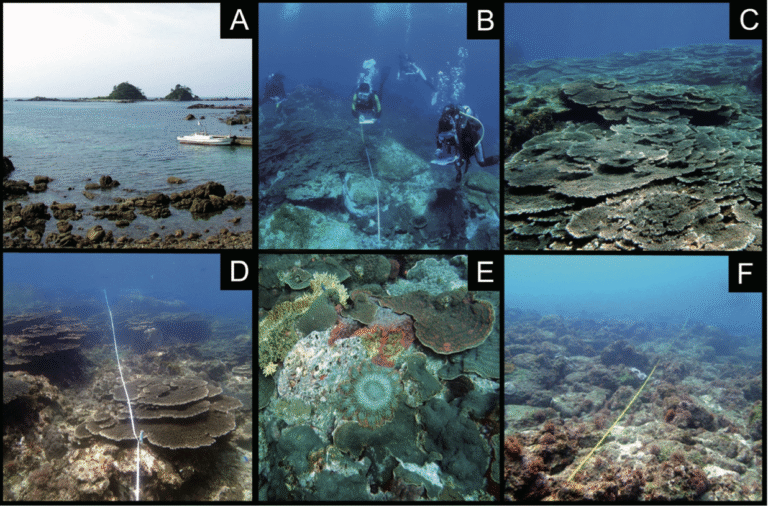
Picture Copyrights: ReefCheck Kushimoto Team – View of the survey point:
A, view of the survey point (Soshima) from land.
B, survey scenery.
C, high-density Acropora hyacinthus community at 3 m depth site (2001).
D, sparse coral community at 3 m depth site (2016).
E, coral community at 10 m depth site (2005), devastated by Acansaster cf. solaris the following year.
F, devastated view at 10 m depth site (2016).
Results
The study categorized changes in marine species observed at two depths (3 m and 10 m) into five types based on their abundance and trends.
- Non-appearance type included species that were not recorded at all and were all non-native southern species.
- Low-appearance type referred to species with fewer than 50 individuals per site, comprising a mix of temperate (35%), native southern (48%), and non-native southern species (17%).
- High-appearance with no trend included species with over 50 individuals but no clear increase or decrease; most were native southern species, with a few temperate ones.
- High-appearance with increasing trend included two species—Gingatakahamagai and Nisekuronamako—that showed rapid growth in recent years, though Nisekuronamako declined sharply in 2024.
- Lastly, high-appearance with decreasing trend included a variety of species such as butterflyfish, clownfish, and sea urchins that showed notable declines, suggesting possible impacts from environmental changes like ocean warming. Coral data were analyzed separately due to different measurement units.
Categories details
No appearance species at both 3 and 10m.
- Grunt,
- Barramundi/humpback grouper,
- Green humphead parrotfish,
- Humphead wrasse,
- Tridacna family,
- Thrush shrimp,
- White spin sea urchin,
- Pipe sea urching
Low appearance species, at 3m
Threadfin butterflyfish
Blue-lined snapper
Red-spotted grouper
Undulated moray
Slipper lobster
Spiny lobster
Red giant sea cucumber
Brown chromis
Crown-of-thorns starfish
Brown sea cucumber genus
Rapa whelk
Fairy wrasses
Moray eel
Juvenile moray eel
Black sea cucumber
Parrotfish
Rockfish
Collector urchin
Lollyfish
At 10m
Threadfin butterflyfish
Slipper lobster
Red giant sea cucumber
Undulated moray
Rapa whelk
Brown sea cucumber genus
Triton trumpet
Red-spotted grouper
Grunt / Sweetlips
Crown-of-thorns starfish
Juvenile moray eel
Moray eel
Brown chromis
Banded coral shrimp
Parrotfish
Rockfish
High appearance species, with no trends
At 3m
Thunder wrasse
Black-axil cardinalfish
At 10m
Rainbow wrasse
Thunder wrasse
Whipfin wrasse
Bluestreak cleaner wrasse
Blue damselfish
Nagasaki damselfish
Black-axil cardinalfish
Silver-lip pearl oyster
Long-spined sea urchin
Black sea cucumber
High appearance species, with increasing trends
At 3m
Silver-mouth clam
At 10m
False black sea cucumber
High appearance species, with decreasing trends
At 3m
Butterflyfish
Wrasse (Nishikibera)
Cleaner wrasse
Clownfish
Sapphire damselfish
Nagasaki damselfish
Variegated top shell
Crimson spindle shell
Diadema urchins
Echinometra urchins
At 10m
Butterflyfish
Clownfish
Variegated top shell
Crimson spindle shell
Echinometra urchin